

Commentary
This year’s wars have made alternative routes to transit through Russia no less risky for Central Asian countries.
Galiya Ibragimova
{
  "authors": [
    "Friedrich Conradi"
  ],
  "type": "commentary",
  "blog": "Carnegie Politika",
  "centerAffiliationAll": "",
  "centers": [
    "Carnegie Endowment for International Peace",
    "Carnegie Russia Eurasia Center"
  ],
  "englishNewsletterAll": "",
  "nonEnglishNewsletterAll": "",
  "primaryCenter": "Carnegie Russia Eurasia Center",
  "programAffiliation": "",
  "regions": [
    "Caucasus",
    "Central Asia",
    "China",
    "Europe"
  ],
  "topics": [
    "Trade",
    "Global Governance",
    "Security"
  ]
}
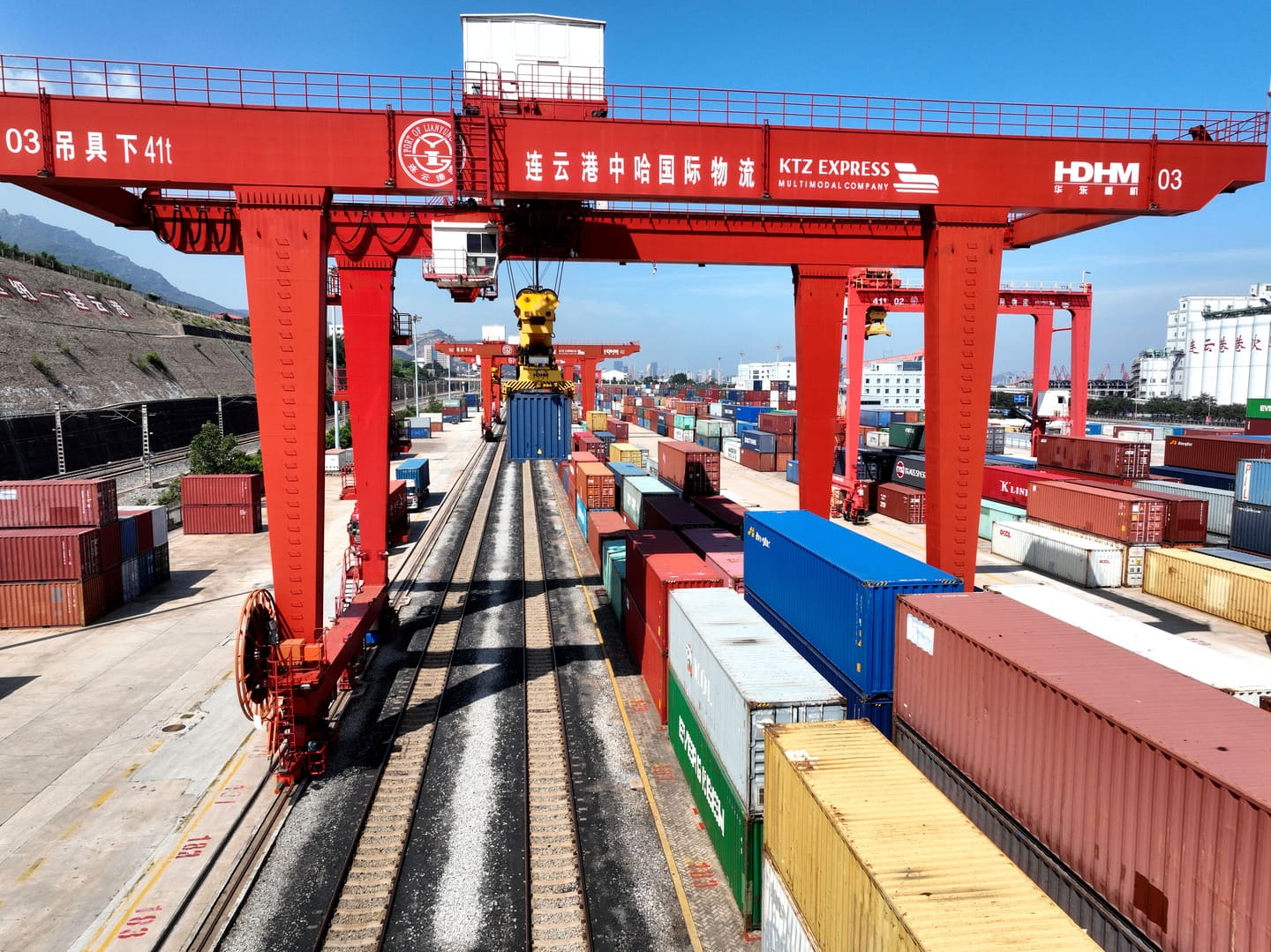
Source: Getty
For the Middle Corridor to fulfill its promises, one of these routes must become scalable. At present, neither is.
In the wake of Russia’s full-scale invasion of Ukraine and the most recent wars in the Middle East, experts and politicians expected a major transport route to emerge through Central Asia and the South Caucasus, bypassing sanctioned Russian and Iranian territory: the so-called Middle Corridor. For the EU and United States, the corridor holds dual promise: as a trade link between China and Europe and as a strategic pathway for Central Asia’s vast reserves of critical minerals, which are essential for the energy transition and defense industries.
In 2025, the planned Trump Route for International Peace and Prosperity (TRIPP) through Azerbaijan and Armenia further established the Middle Corridor as a widely discussed alternative to transit through Russia. But obstructive governance, persistent infrastructure gaps, climate change, and geopolitical risk stand in the corridor’s way and may impose a time horizon on its viability. Accordingly, for Central Asian states, the Middle Corridor offers not a permanent pathway to European markets, but a window of opportunity that should be leveraged strategically.
The Middle Corridor, or the Trans-Caspian International Transport Route (TITR), is a 4,000 kilometer multimodal transport network linking western China to Eastern Europe via Central Asia, the Caspian Sea, the South Caucasus, the Black Sea, and Türkiye. In 2024, cargo volume along the Middle Corridor across the Caspian Sea increased by more than 63 percent year on year, reaching 4.1 million tons (compared with 500,000 tons before Russia’s full-scale invasion). The increased throughput of Georgia’s biggest ports, Poti and Batumi, suggests this trend continued in 2025, as the full data are not available yet.
Historically dominated by energy products, the corridor is shifting toward containerized traffic and is increasingly promoted as a future route for Central Asia’s mineral wealth, including uranium, copper, tungsten, and titanium. For the region’s landlocked states, the Middle Corridor represents an opportunity to reduce export dependence on China by diversifying toward EU and U.S. markets. For the EU, it is a flagship project of the Global Gateway strategy, envisioned as an alternative route to diversify critical mineral and energy supply chains while reinforcing strategic autonomy and de-risking from Russian transit.
But impressive growth rates obscure a sobering reality: the Middle Corridor remains far from competitive. It only handles about 6 percent of the Northern (Russian) Corridor’s annual capacity of 100 million tons, and while many in the West expect the Middle Corridor’s continued growth, several indicators point in the opposite direction.
Until the TRIPP corridor connecting the Azerbaijani heartland to Türkiye via southern Armenia and Azerbaijan’s Nakhchivan exclave becomes operational, Georgia will remain the Middle Corridor’s sole gateway to Europe. But although the country’s existing port capacity is nearing exhaustion, the Georgian government has slashed the new Anaklia port’s 2026 funding from 150 million lari ($56 million) to 50 million lari. The planned deep-sea port, designed to handle vessels that Georgia’s other ports cannot accommodate, has been identified by the World Bank and the EU’s Trans-European Transport Network plan as a central corridor priority—yet Tbilisi seems uninterested in building it. The government has also shown little willingness to meaningfully expand the ports of Poti or Batumi.
In Georgia, explanations for this change of course vary widely, ranging from the government realizing that while demand might exceed the capacity of Poti and Batumi, it is far from sufficient to justify a project of Anaklia’s magnitude, to Russia putting pressure on Tbilisi to try to prevent the Middle Corridor from permanently replacing traffic on its own Northern Route.
Another possible explanation is China’s limited interest in completing the port. After the original Anaklia construction project, led by a consortium including Western firms, was canceled in 2020, the Georgian government selected the Chinese-Singaporean (and U.S.-sanctioned) CCCC as its preferred contractor. By all appearances, it was a done deal. Yet as of March 2026, the Georgian transport department was maintaining that the decision had not yet been made. Chinese disinterest, if confirmed, would cast further doubt on the corridor’s near-term prospects.
Whether the obstacle is insufficient demand, Chinese disinterest, or Russian geopolitical pressure, the implications for the Middle Corridor are the same: its most critical piece of infrastructure in Anaklia remains stalled.
In an attempt to work around Georgia, the United States has recently focused on establishing the TRIPP route through Armenia. U.S. Vice President JD Vance’s February visit to the South Caucasus, pointedly skipping Georgia, underscored this shift. Yet bypassing Georgia may mean trading one set of risks for another. Iran’s demonstrated willingness to escalate horizontally by destroying nearby infrastructure it deems tied to Western powers renders the TRIPP route through southern Armenia (27 miles from the Iranian border) contingent on a regional stability that cannot be assumed.
The South Caucasus, in short, offers no easy path westward. Georgia is paralyzed by political dysfunction and stalled infrastructure. Armenia offers a potential alternative, but one shadowed by Iranian volatility. For the Middle Corridor to fulfill its promises, one of these routes must become scalable. At present, neither is.
Another major problem of the Middle Corridor is the drying up of the Caspian Sea, which lies between Central Asia and the South Caucasus. Russia’s damming and regulation of the Volga River, which provides roughly 80 percent of the sea’s inflow, has significantly reduced water discharge. Rising global temperatures are intensifying evaporation and accelerating desertification across the littoral states, which are increasingly turning to Caspian desalination for civilian purposes. As a result, since 2020, the sea level has been dropping by an annual average of up to 30 centimeters.
This is already affecting operations, having reduced rail tank car ferry transport by 22 percent and wagon transport by 10 percent on the Baku–Kuryk route, according to the Azerbaijan Caspian Shipping Company. These are precisely the modes of transport on which critical mineral shipments depend.
Should this trend continue, Kazakhstan’s ports of Aktau and Kuryk could face a critical threshold: a projected sea level drop of up to 6.5 meters could leave current berths landlocked by 2045, potentially forcing a transition from shoreline operations to offshore deep-water terminals and constant multimillion-dollar dredging to remain functional.
For Central Asian countries striving to realize their critical minerals potential, this means a limited window of opportunity and the need to pivot from raw material exports toward attracting Western investments in downstream processing. Such an approach would help them to diversify economic partnerships, hedging against China’s focus on raw material extraction from the region.
Kazakhstan has already struck a $1.1 billion tungsten deal with the U.S.-based Cove Capital Group, which requires construction of domestic processing plants, pushing Beijing to respond by accelerating its own investments in Kazakh processing capacity and regional connectivity. But this leverage exists only as long as the Middle Corridor remains operational.
The Middle Corridor has hard bottlenecks and likely a limited shelf life. Georgia’s paralysis over Anaklia, geopolitical volatility in the South Caucasus, and the environmental degradation of the Caspian Sea constrain future throughput to a fraction of what an alternative to the Northern Route would require. For Central Asia, the current Western demand for critical minerals offers a fleeting opportunity to negotiate for domestic industrialization. Western developmental institutions should support this by facilitating the regional coordination of industrial policy rather than pushing these countries into rivalry on the mineral market. If Central Asian states compete individually for export contracts, high processing entry costs and Chinese economic statecraft will drive them to sell raw ore at depressed prices with no domestic value addition: a trap that becomes inescapable if the corridor closes.
Views do not represent the World Bank.

Friedrich Conradi
Journalist and student of international relations at Johns Hopkins SAIS in Washington D.C. Student researcher on critical minerals trade and investment in a SAIS–World Bank program.
Carnegie does not take institutional positions on public policy issues; the views represented herein are those of the author(s) and do not necessarily reflect the views of Carnegie, its staff, or its trustees.

This year’s wars have made alternative routes to transit through Russia no less risky for Central Asian countries.

Galiya Ibragimova
Reestablishing a dialogue with Moscow is not a goal in its own right. The goal is to guarantee the independence of Ukraine and the peace and security of Europe.
Arkady Moshes
Ukraine’s increasingly confrontational posture on Belarus reflects Kyiv’s effort to shape the emerging regional order in Eastern Europe. Kyiv wants to limit European normalization with Minsk—and any future rapprochement with Russia.

Balázs Jarábik

Pashinyan’s pro-European party has been re-elected with a decisive victory. But the pro-Russian opposition could still slow Armenia’s progress toward peace with Azerbaijan and rapprochement with Europe.

Mikayel Zolyan
For all the menacing rhetoric, the Armenian prime minister remains a leader with whom Putin is prepared to interact: not as an ally, but as a partner, albeit a problematic one.

Alexander Atasuntsev